BOOK REVIEW
By Aleya Kassam
“Everyone has a book inside of them—but it doesn’t do any good until you pry it out” – Jodi Picoult
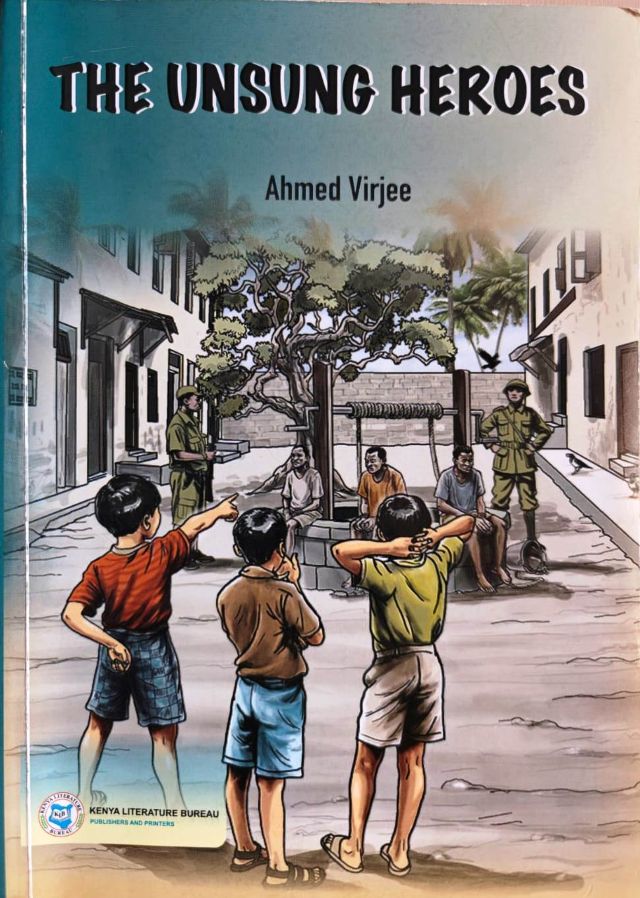
I had been sitting with this book for several months before I opened the first page. It lay on my bedside stand alongside Mahmood Mamdani’s Slow Poison, and I was waiting for an uninterrupted weekend to enter the world Ahmed Virjee created for us. That time came over Easter, and as enjoyable a reading experience the novel was, I got the sense that Virjee himself had an even more enjoyable time prying it out of his mind.
The first few months of this year had been tough for our family – we had recently lost an uncle who had grown up in Uganda and then moved to Kenya. In that way that families do after losing a loved one, we had been tenderly tracing his life, the elders in my family sharing stories about his youth in Uganda from a time that seemed unrecognisable to younger generations. It is with the echoes of these stories and those worlds that I read the blurb at the back of the cover.
“In the sun-scorched streets of Mnazi Moja, Mombasa, where colonial rule casts a long shadow, young Amar’s world is a vibrant tapestry of adventure and friendship. Born to a struggling Kenyan Asian family, he finds paradise in the bustling Society Flats, unaware of the looming storm.
As the Mau Mau struggle for independence simmers, Amar’s idyllic childhood shatters when forced to Uganda by financial hardship, he’s thrust into a whirlwind of political upheaval-from newfound independence to the ruthless dictator.
Against this tumultuous backdrop, a community of vibrant characters emerges. From daring escapes to covert acts of rebellion, each page bursts with courage, humour and humanity. Amar and his unlikely band of heroes fight not with guns, but with wit, compassion and an unbreakable will to survive.
Ahmed Virjee’s debut novel is a powerful tribute to resilience, bringing to life the everyday heroes who defied oppression and found strength in the most unexpected places”
The novel joins a growing archive of stories about East African Asians from the period straddling independence, and as with many, you can feel the patina of nostalgia and the tenderness that comes with the grace that time offers. Unlike many similar novels written from abroad, Unsung Heroes doesn’t feel like a novel written from the distance of diaspora, as much as it is written from the distance of time. In so many passages, you feel that the author was right there, experiencing a version of what he shares in the pages of the book.
My favourite passages were the ones from Amar’s adventurous childhood with his friends, hearkening back stories that my own dad used to tell me from his time as a student in Mombasa. We follow Amar from Mombasa to Kampala where he studies medicine against the backdrop of Idi Amin’s growing power, and then to Nairobi where Amar establishes his professional life. At some point, the point of view switches to his friend Hari, through whom we experience the harrowing experience of the expulsion. Whilst we get a very personal taste of what life was like then for a young man, growing into adolescence and then adulthood, with the struggles that come along, as well as the joys and mischiefs, I did find myself craving a deeper insight into the politics of the moment – there is scant mention of the independence struggle in Kenya, and the dynamics post-independence. In some ways it felt like the community Virjee writes about existed in a bubble, which made me wonder if this was indeed a reflection of the community’s experience at that time, or a deliberate choice by the author to look at these lives from an intimate lense that often blurs out everything on the periphery. I also found myself asking where the female characters were.
By the end of the novel, I had developed a close fondness for the characters, and turning the last page felt like saying goodbye to family I had just discovered. I was really moved by the deep friendship and the ways that the community was there for one another – which is a narrative that is often shared about the Asian community, but is important to note, is not at all exclusive to the Asian community. The experience of reading Unsung Heroes, as it sometimes jumped through passages of time, bringing colour through vivid anecdotal moments, and switching points of view, felt like sitting over chili fried muhogo and masala tea, listening to someone tell the stories of their time, and as an East African Asian myself, whose family moved around the region in response to the political dynamics of the time, there was a comforting familiarity about these stories. I am glad this novel exists. And whilst it isn’t autobiographical, I am glad Ahmed Virjee was so generous with his memories.